|
||
|
|
||
Soviet Union started preparation to a “great war” in the middle of 30-ties. It seems that there was planned a massive attack, not the defense. This process was intensified after the Spanish civil war. The slogan “give the Fatherland 10 000 fliers” was set by the Bolsheviks party. Such slogans played important role in focusing the society around particular tasks.
To prepare 10 000 army fliers, you have to begin with much more students of the first-stage air trainings. About 100 000 young men and women were trained in the Ossovakhim aeroclubs. What is interesting, many young communists and members of Konsomol were directed to these courses by their organizations. It is exceptional event in the history, that the fliers were not the volunteers! [3]
In fact, 10 000 was an insufficient number. On 22nd June 1941 Soviet Union had over 17 000 planes in the European part of the country. To prepare enough crews for them, the training of the pilots was dramatically reduced – from 30 to 14 months. It had a serious impact on the quality of the airmen. Such inexperienced pilots, flying on obsolete I-16 or I-153 fighters, without the radio connection, and under inadequate command, had little chance to survive.
To the end of 1941 Soviet Union has lost 17 600 airplanes (from this total about 10 300 were destroyed by the enemy) – practically all its pre-war stock (according [2])! In such desperate situation there was no other option, than to train new pilots as quickly, as possible.
Typical education of young Soviet pilot in that time was following:
Usually he received, along this way, a rudimentary preparation, only. If the unit was created as a completely new one, usually it lacked any experienced pilots. Such men would form the “skeleton” of the new regiment. When they were absent, the chances for the rest flying staff to survive were low. Especially, when they were send into a fierce battle, like the one over Stalingrad.
There is an example of 240 IAP, which was formed on August 1942, at 2nd ZAP. They had 15 days of the training there, only. It was led by major Soldat’yenko, who had chance to take a part in the Spanish civil war. Well, it was not enough. How much hours could a young pilot fly, during two summer weeks of the training? 20? 30? Without enough tactical preparation they were thrown into the fight on 20th August, 1942, at Stalingrad.
The Luftwaffe held the air supremacy, there. During next 9 days this regiment made 109 sorties and took part in 58 aerial combats. Claimed 9 Me-109 and one Ju-88 shot down. Lost all its airplanes and most of its pilots. The regiment should have 36 fighters (3 squadrons, 12 planes in each), according the standard, but entering the battle 240 IAP could have less – somewhat over 20.
On 29th August it was withdrawn back to the 2nd ZAP, to be formed anew.
|
|
||
|
|
||
The regiment received a better pilots, this time. Some of them served previously as the instructors in the fighter schools, and had hundreds of hours spent in the air. It seems that at the end of 1942 part of this experienced staff was released to the front. Probably the high command decided, that it is possible to conduct the next courses in the schools with a “new generation” of the flight instructors. What is also important, at the end of 1942 Red Army become less “bolshevik” and more “professional”. The role of commanders was increased, and the absolute competency of accompanying politruks was somewhat reduced. There were some visible aspects of this changed attitude: the military rank signs on the uniforms were moved from collars to shoulders. Now the officers have them on the pagons, like in the Tzar ‘s army! For Soviet soldiers it was unbelievable change. The suprise was so great, that even some rumors emerged, about cancelation of the collectivization, after the war…([1]).
Officers and soldiers in this new situation become more self-confident. They had also more time to prepare themselves for the next battle.
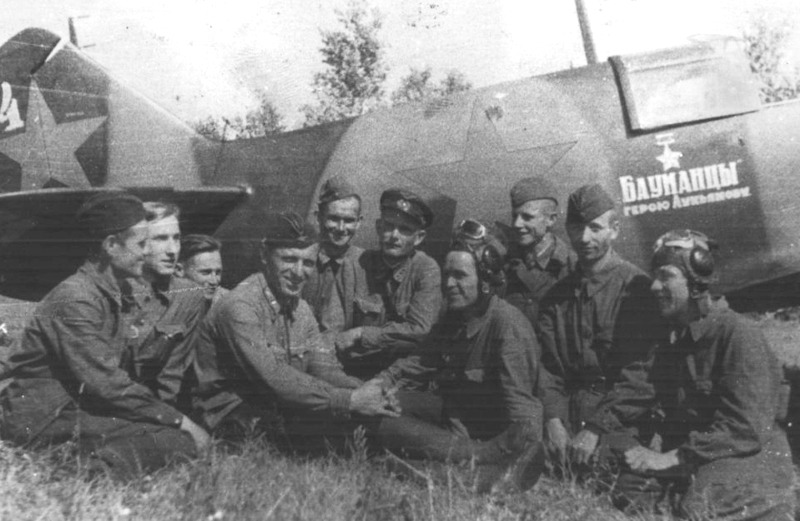
In the group directed to 240 IAP was a pilot named Ivan Kozhedub – an experienced flight instructor, who, after many requests, finally got the assignment to a combat unit. It seems, that it was not very easy, anyway, for such fliers to get to the front. I have found in [3], an interview with Aleksandr Khayla (Александр Хайла). During this interview he said: “I had met Ivan Kozhedub in Chimkent (Middle Asia), in 1942. We were instructors of the fighter school, located there, and had served together for a month. He was in the 5th squadron. After my dispatch to the front, he once had drunk a lot, and beat somebody. He was quickly found guilty by the court-martial, and also directed to the front”. Of course, you will not find this story in the official Kozhedub’s autobiography!
After this “reformation”, 240 IAP went to the front, again, on January 1943. At the beginning, Ivan Kozhedub received the worst machine in the regiment – La-5 with doubled fuel tanks, having tactical number “75”. (There is no advantage of additional fuel, when the rest of the group has smaller tank capacity. Even if you do not fill them, it is just an additional weight - they were protected). His colleagues joked, that he can be used as the flying tanker…It was not very lucky airplane for this pilot. During the first fight Kozhedub was too concentrated on a Me-110, he wanted to shot down. Attacked by a Me-109, sheltered by the AA fire of own artillery, he grounded his damaged “white 75” with great difficulty. It was estimated that it would take over month to repair it. As a fighter without any plane, he was entitled to accompany the ground troops, and direct the planes from the ground, by the radio. It was also important role, but not for him. He begged many times mjr Soldyatenko to let him to fly. Finally the commander had agreed, and directed to the ground command task somebody else. Otherwise the Soviet Union would not have its greatest ace!
240 IAP took part in the big aerial battle over Kursk salient, fought over Dniepr river, Kiev, Romania… Kozhedub finished the war with 62 confirmed victories (+ 2 P-51s from USAAF, which attacked him over Germany).
It seems, that the key point for the VVS, to fight back the Luftwaffe, was the quantity and experience of its staff.
At the beginning of the war Soviet air regiments many times outnumbered Luftwaffe forces. But this number was not evident, because they were dispersed, each one assigned to an army, under direct command of the commanders of the ground troops. Army officers had not enough knowledge, how to use the air force. Sometimes Soviet fighters had “to fly slowly on the low altitude, to raise the spirit of the ground troops”. Germans had no troubles in destroying such easy targets. Soviet fighters used obsolete tactics (tight formation of 3 airplanes – zvieno, and its multiplication). Their machines lacked radio equipment, and were rather obsolete. Anyway, the Luftwaffe had not succeeded in destroying all the VVS in 1941. During the winter 1941 – 1942 it recovered a little, receiving more modern planes from the evacuated industry and the lend-lease deliveries. It was the Russian winter frost, that grounded most of the Luftwaffe. It allowed the VVS to take “the second breath”.
Since spring 1942 Soviet air forces units had outnumbered the German units, and the air units of its allies, all the time. They were also grouped in bigger tactical units - air divisions, and later - air armies. But, because of the lack of experience of the young VVS pilots, Luftwaffe still held the air supremacy. Brutally speaking – German fighters were able to maintain the “dynamic balance”, like classic predators. They were able to kill most of the Soviet pilots before they get a chance to obtain the first, most important experiences and stay alive. (Typical La-5 was destroyed after 40 combat flights, Yak-1 – 45).
In 1943 VVS put better pilots in the line units, and they started to learn as much, as possible, from their enemies. This accumulated experience allowed VVS to slowly move the balance of the air power. Over Kursk salient they outnumbered the Luftwaffe (about 2:1). Because of the higher effectiveness of German air force, the air supremacy remained on their side. VVS lost about 800 airplanes there (mainly fighters), against 200 lost by Luftwaffe (mainly bombers). Despite of such heavy losses, VVS was able to deliver about 1000 new fighters, and successfully support Red Army on its counteroffensive there, on August. Luftwaffe was outnumbered again, and this time the part of its opponent forces, which passed the Kursk battle, had gained enough experience. In the second half of the 1943 allied bombers started the air offensive over Germany. Luftwaffe already had 2/3 of its fighters located there ([4]), but it was still not enough. What's more, about 15% of the German forces were withdrawn, at the end of July, from Kursk, and dropped to Sicily, to defend it against RAF and USAAF. The lack of these units on Eastern Front soon become evident. On August 1943 VVS started to knock down much more German planes, than before. This new tendency allowed them to conduct the fights over the Dniepr river and Kiev in autumn 1943 on the more or less equal terms. The further drainage of Luftwaffe fighters from the Eastern Front took place on the winter 1943/1944. More fighters were needed to defend Germany against the new USAAF offensive. Although in 1944 Luftwaffe has, in total, 800 fighters more than in 1943, most of them was directed to the Reich area. Only 23% of the Jagdwaffe airplanes operated over Eastern Front, on February 1944. In this time VVS grown not only in the quantity, but also the quality of its pilots. Finally, it allowed VVS to take the air supremacy over the whole front, in the spring 1944.
[1] Catherine Merridale: Ivan’s War. The Red Army 1939-45, 2005
[2] Schwabedissen W. Russian Air Force in the Eyes of German Commanders. — Ayer Co Pub, 1968
[3] Артем Драбкин: Я дрался на истребителе. Принявшие первый удар. 1941 1942. - „Война и Мы”, 2003
[4] Richard J. Overy: The Air War 1939-1945, 2005