|
|
|
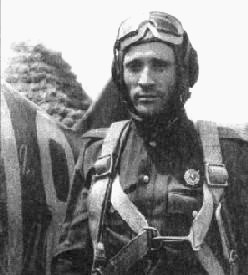
Lieutenant Ivan Sytov (Иван Сытов) has joined 5th GIAP (Гвардейский Истребительный Авиационный Полк - Guardian Fighter Aviation Regiment) on December 1942. It was time, when this regiment, withdrawn after intensive battles on the Kalinin's Front, had trained on their new fighters - La-5. He arrived together with the group of new pilots – the replacement of previous combat losses. As other officers from this group, he was an experienced flight instructor, 26 years old. Served previously in Stalingrad’s fighter school, then on the Far East (according [2]), and then in 788 IAP PVO (PVO means “Air Defense”). In 788 IAP Sytov destroyed at least 1 Me-109, on September 1942.
5th GIAP was one of the units that distinguished very early during the Soviet – German conflict: it received the guardian name as one of the first regiments, on December 1941. (It was 129 IAP, before). At that time it destroyed 62 German airplanes in the air, and 20 on the ground. (It was less, than it lost its own planes. On 22nd June 1941 it counted probably 60 fighters and pilots. All machines were lost. On the next month the regular size of VVS fighter regiment was reduced to 36 fighters. On November 1941 129 IAP had 20 airplanes) After the ceremony, 5th GIAP was directed to Kalinin’s Front.
After one and half year of the war, on December 1942, this regiment had still some
experienced fighters, that had fought in it since 22nd June 1941.
These pilots had accumulated hundreds of combat flights. It was rather unusual in Soviet Air
Forces, where the typical loss ratio was very high, during first years of the war (see more
about it here). In 1941,
for example, many fighter regiments were annihilated in less than two weeks, because of poor
tactics, obsolete equipment, improper command, the lack of the experience and training ([7]).
Such enormous losses could also happen in 1942, especially over the Stalingrad area.
5th GIAP
“had something”, which allowed its pilots to fight better than many others, and survive longer.
Maybe it was its commander, Vasilii Zaytzev (Василий Зайцев)? He had the experience from the
conflict with Japan. In 1939, at Khalkhyn-Gol, he downed 6 Japanese airplanes. What’s more,
it seems that he was also a good coach for the new pilots. The regiment quickly adapted to the
new situation. At the end of 1941 pilots of 5th GIAP already applied Luftwaffe tactics
to fly in pairs, and used formations based on this smallest combat unit. It seems, that the
newcomers received at this regiment a better training, than elsewhere, from some veterans,
especially: Vasilii Efimov (Василий Ефремов) and Vasilii Naydienko (Василй Найденко).
5th GIAP has reached 500th aerial victory at the end of August 1943. I have found in [5], that to the end of the war its pilots destroyed 729 German planes in the air, made about 23 900 combat flights. They lost 82 pilots (for sure, more airplanes – but their number was not given there. Usually this number is higher by about 50%, which can be estimated on about 120 airplanes lost in the air fights)
5th GIAP took part in the last stage of the battle of Stalingrad – it entered it on 15th December 1942. The main task for the Soviet fighters that time was to break the supply of the goods, delivered to encircled German 6th Army by the Luftwaffe transport airplanes. Because of winter offensive, German airfields shifted far away to the West. Their Me-109 fighters had too short range, to cover the transport planes. For VVS it was a time of “hunting” for Ju-52, He-111 and Ju-88, which tried to fulfill their task. A good time for Ivan Sytov to show himself. During first month he destroyed 2 machines individually, and another 2 with the others. Whole regiment destroyed 45 airplanes that time – nearly 10% of total 488 German bomber an transport machines, shot down by VVS in this campaign.
|
||
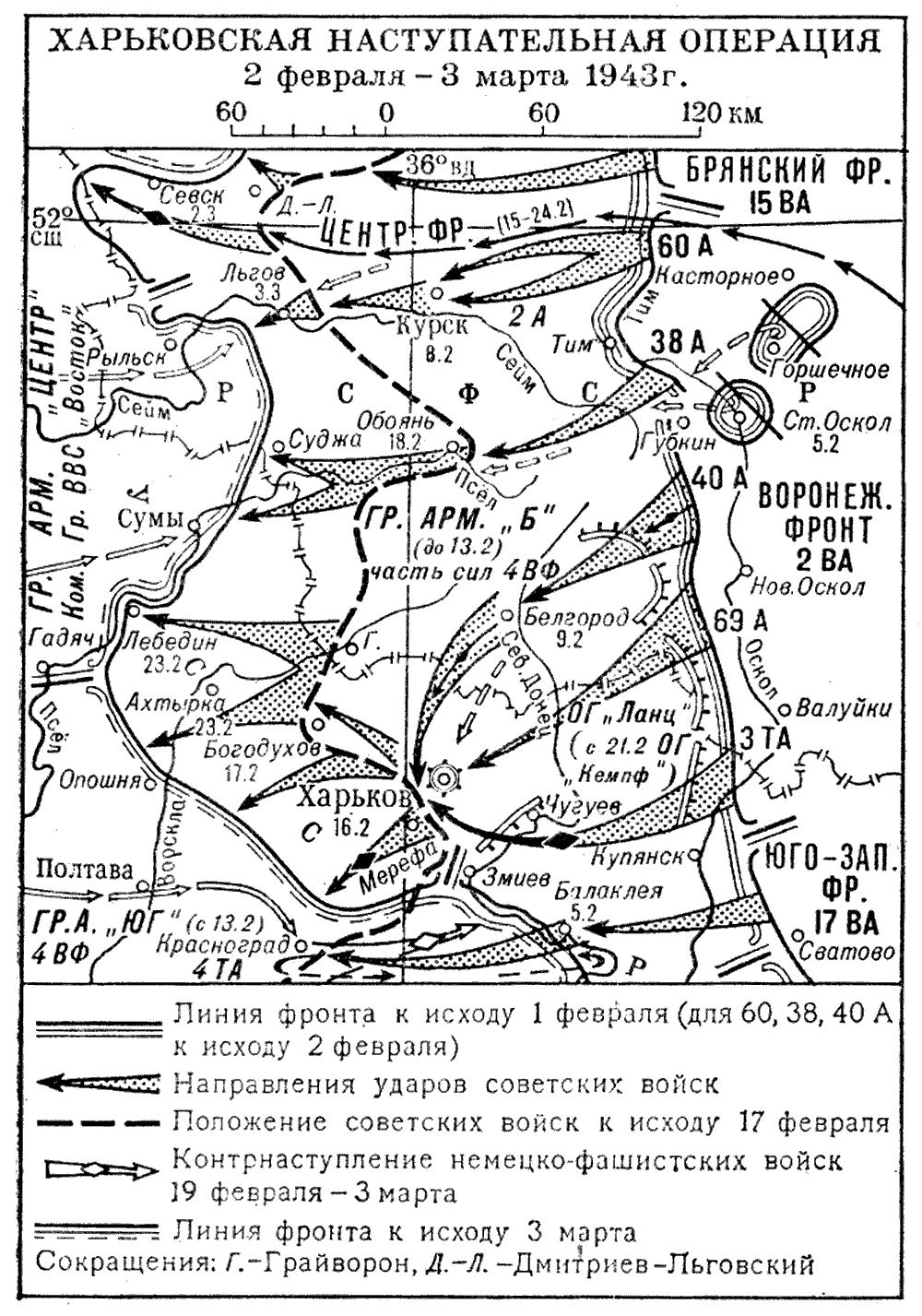
On 2nd February another Soviet offensive over eastern Ukraine was started. Red Army moved forward into the Kharkov region. It was time of intense combat flights for the regiment.
Kharkov (Харьков) – the biggest city in this area – was liberated on 16th February 1943.
On 14th February Sytov destroyed He-111, during fierce battle over own airfield. (The Luftwaffe tried to destroy a regiment of Pe-2 bombers, which had landed there during that night, on their return from an action).
|
||
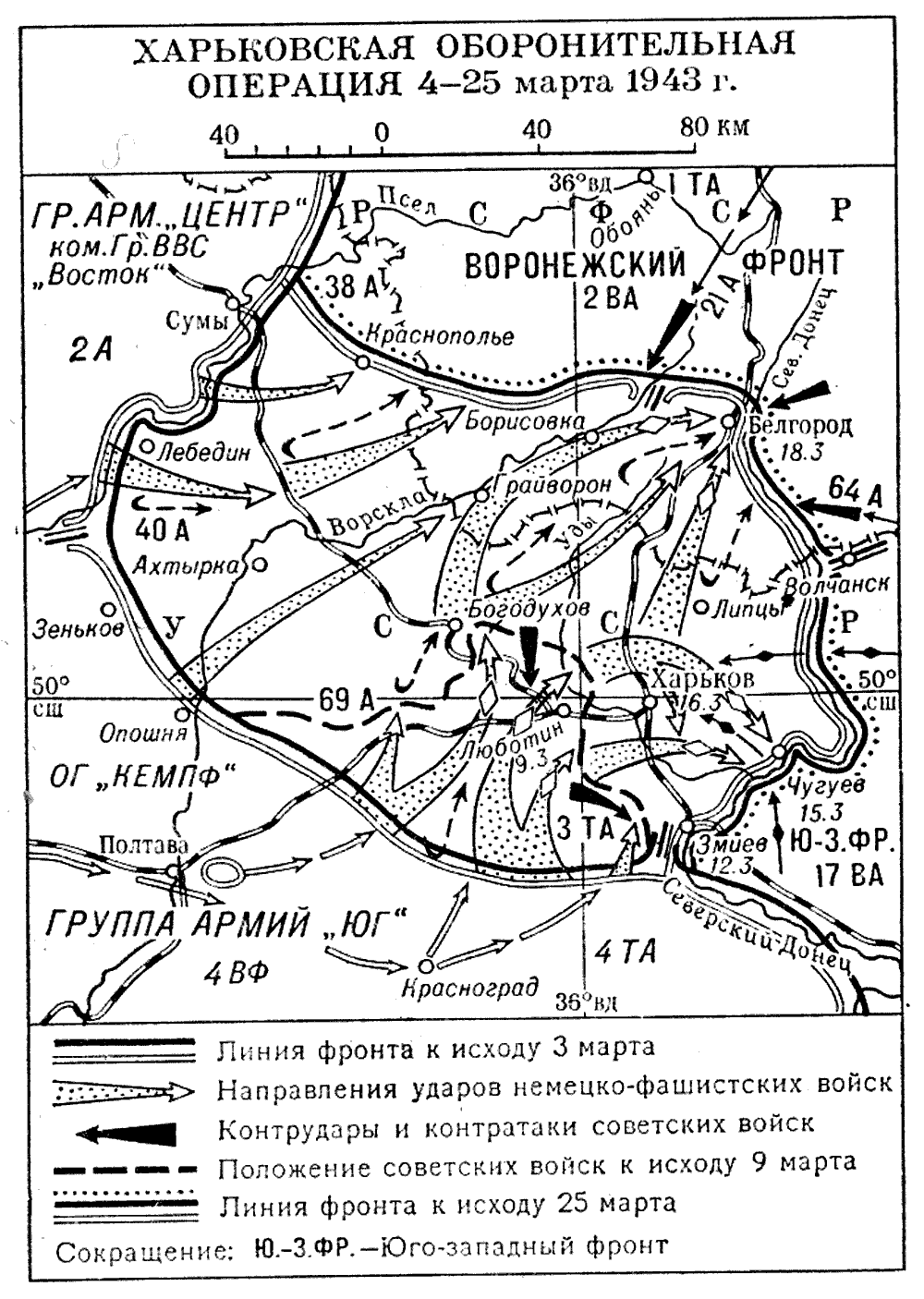
On the 19th February the tide of the war was reversed: German armies started a counteroffensive. Soviet troops were exhausted, they had less than 30 tanks available. O the other hand, German forces had recovered very quickly. In unbelievable short time – a few days - they ensured a local supremacy in all quantities: soldiers (2x) tanks (11x), airplanes (3x) and artillery (2.5x). First time, with significant success, they used battalions of new heavy tanks: Pz Kpfw IV “Tiger”.
After intensive fights, Kharkov was captured by Wermacht on 15th March 1943. The Soviet armies retried from it, to not be encircled by attacking German troops. The front stabilized along Sieviernii Doniets (Северный Донец) river (about 35-40 km east Kharkov). It was a big German achievement.
A reader could compare it to similar situation, which appeared in North Africa on 1941 and 1942: victorious British troops reached the area far to the west, then were beaten back, and returned into their start position.
But there is one very important difference: the civilian inhabitants of North Africa remained neutral for the whole conflict, and did not receive any special harm from any side (at least, I have not learned about anything). For the inhabitants of Kharkov, who actively supported the Red Army during the winter offensive, it was a big tragedy. The Stalin's system, returning on the back of Red Army, had punished all, who were suspected to support Germans in any way. The coming back Nazi forces took their revenge on the others, who were suspected to support Red Army.
According source [1], on 3rd April Sytov led four La-5, covering Soviet crossings on Sieviernii
Doniets river. They spotted a group of He-111 bombers, approaching from the west. La-5s broken
their formation, downing four machines. Sytov approached a He-111, and gave it a long burst
from both guns. Heinkel’s rear gunner was killed or wounded, because he was not responding with
a fire. The bomber started to maneuvering, then dropped its bombs and headed to German lines.
Sytov caught him up, and fired short bursts to its fuselage and wings. They should set a fire,
but it did not appear. Heinkel continued its escape. Sytov attacked again, pressed the trigger,
but the guns did not shoot – the ammunition was finished. At this moment he decided to hit the
enemy machine, anyway. Turning on the engine boost, he rapidly accelerated. His wing hit the
bomber’s wing. Heinkel went into a spin, from which it did not recovered.
This kind of attack is called in Russian taran. I will use that word in this article, because it is simple, and has no direct equivalent in English (“aeroroam”? I am not sure). Tarans were sometimes used on the Eastern Front, by Soviet pilots determined to destroy enemy at any price – even their own life. (Statistically, the attacking pilot was killed in 37% of tarans). Maybe there was also an element of desperation? Most of the Soviet tarans (2/3) occurred in 1941 and 1942. It was time, when the Luftwaffe kept the air supremacy over whole Eastern Front. You can imagine, how felt a Soviet pilot, who saw his colleagues decimated by a German “Experte”, spent all ammunition in the fight, and suddenly saw the hated enemy plane straight behind? Air war on the Eastern Front did not even pretended to have any “fair play” rules. It was just a part of the overall conflict, fought without any excuse. Both sides knew it. Soviet pilots – the easy prey of the Luftwaffe during first two years – knew it even better.
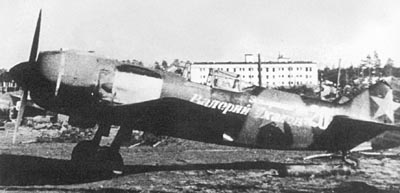
There is no information about the damage of the Sytov’s airplane. Because few days later (on the 5th April) he destroyed two Me-109s, it is clear that he personally received no harm, during this taran. La-5’s wing was divided into three sections: the center and two outer panels, each connected by four bolts. The leading edge of the outer section contained automatic slots, built from two layers of thick dural. It is most probable that Sytov hit the bomber with this part. Its metal slot could act as an “armour plate”, shielding the inner, wooden structure, from direct contact with the sharp metal edges of destroyed He-111. If he hit the bomber’s wing with its end – maybe La-5’s wingtip was lost, but the airplane returned to the airfield. There was a chance, that all of four nodes, keeping the outer panel in place, were not deformed (wood is a good shock absorber). In this case the technical staff could just replace the damaged outer wing panel with another one, and the plane would be ready for the next day. In this case Sytov could do this taran on his La-5F “Valerii Chkalov”, which model is presented on this site. According [2], this airplane was handed him on February, but this date seems to be impossible. Production of the La-5F with enhanced visibility was started on March 1943 (according [4]).
|
||
Otherwise, if the Sytov’s La-5 was lost in effect of this taran, the “Chkalov” La-5F could be handed him on April. Anyway, at the beginning it could look like the airplane shown on the picture, on the right. Initially the tactical number of Sytov’s “white 18” could have shape like this “20”, on the Photo 2. It was a typical digit style, used by the producer - Facility No 21 - during the 1941-1942 period. It was replaced by a larger tactical number - the one pictured on the model, and visible on Sytov’s La-5 (Photo 1) – most probably during the summer 1943.
The story, cited from [1], contains some strange errors. For example, it describes the goal of the flight as “covering of Soviet crossings on Sieviernii Doniets river”. There were no such crossings on 3rd April! Both sides had already sat in the trenches, and the positional war across this river took the next 4 months. Next, source [1] contradicts itself. First it states, that Sytov has destroyed 3 Me-109 and 1 He-111 between 3rd and 5th April, 1943. From the description of the 3rd April fight, it seems that Sytov already downed one bomber (four fighters attacked - four bombers downed at the first attack), when he attacked the second one. What’ more, it tells, that the attacked group of He-111 was “big”. You will see further in this article, that author of the source [1] sometimes exaggerates. I remember, that all Soviet fighter pilots in their interviews (in source [7]) underlined, that a bomber – Ju-88 or He-111 - was the airplane most difficult to shot down. Isn’t the effectiveness of this first attack, described in [1], too high? 100%! Could the four fighters disperse the formation of a big bomber group in the first attack? Even if they succeeded to down four of them, the German pilots would just tighten their formation. The text [1] is not undersigned by any author. It is very similar to the other biographical notes about Ivan Sytov, I have found on the Web. I think, that they all were excerpts from the same, single source, which contains all these errors.
Surprisingly enough, there is another version of this fight, in source [6]. It is stated there, that Sytov hit the bomber’s wing with the wing of his La-5, then (!?) destroyed it, using guns. Very strange method, indeed! The note [6] also has no author…
In general, source [2] seems much reliable, because it is a book, written by two chiefs of the
5th GIAP’s ground staff. They served in it from the beginning to the end of the war.
This book contains a collection of stories, about the pilots, their fights, and –
sometimes – the achievements of the technical staff. For example – a note about the technician,
who resolved the problem of burnt sparkling-plugs on the early Ash-82 engines. It seems, that
the authors uses typical, in the Eastern Block, style of the war books. You can find
there positive things, only! For example – they have carefully described, how on 22nd June 1941
the regiment successfully defended their airfield during first attack. They did not tell, that
subsequent attacks of the Luftwaffe were more successful, and German bombers destroyed 27 MiG-3s and
11 I-153s on the ground (over half the regiment’s airplanes – according [5]). Source [5] describes
the evacuation of the unit into another airfield – only part of the pilots had their planes.
They flew them, but the rest of the airmen have to fight back their way to the East together
with the infantry. Source [2] does not mention, that most of them had not reached their destination
(their fate is unknown – according [5]). But, source [2] does not tell any fairy tales, anyway, like
some of the Sytov’s biographical notes, published on the Internet.
What is written in [2] about Sytov’s taran? Nothing! You can find some information about his achievements at the end of the March and beginning of April (page 167):
In another fragment of [2] (page 139), it is stated, that between 3rd and 6th April Sytov shot down 3 Me-109 and one Me-110. (Compare it to the version from [1], presented at the begining of this section). It is also stated, that he did it on the fighter, handed him on February (!? – a little bit too early for La-5F…) by the collective workers from the Gorky region. It is without doubt, a “Valerii Chkalov” machine – but it is not obvious, if it was this La-5F “white 18”.
There is no information about any taran on 3rd April, in the source [2]! But, look at the
episode, described in [2] on the page 95:
On 4th February Igor Shardakov (Игорь Шардаков) led four La-5 from 5th GIAP, covering Soviet
crossings on Sieviernii Doniets river. They spotted six He-111 bombers. La-5s attacked
aggressively, broken their formation, then concentrated on the individual targets. After
some time, two He-111 were shot down. One of the Soviet pilots – Ivan Kildyushev
(Иван Кильдюшев) – followed “his” bomber.
He set several times the fire on its engines,
but the experienced pilot of the He-111 always managed to damp the flames. During this fight
they moved far away from the German lines. Heinkel, smoking from both engines, entered the
low-level flight. After fourth attack German plane dropped its bombs, to make the machine
lighter for an escape. Kildyushev followed its maneuvers for all the time. He continued to
fire from his guns with short bursts. He killed the bomber’s rear gunner, then the navigator.
Finally, when he pressed the triggers, his guns remained silent. The ammunition was over.
Will the enemy escape, when it is so close? Kildyushev decided to make a taran attack.
He targeted the circle of the rotating propeller to the bomber’s tail. For a moment La-5
flied with the same speed like the bomber, then the pilot pushed the throttle, increasing
the speed. Violent hit! He-111 without rudder weaved, and went down. Its crew did not jump
with parachutes (it could be too low, anyway). After some seconds, it hit the ground, about
5 kilometers on south-west from Nikolayevka village
This story seems to be too similar to the story presented in [1]. It is more realistic, anyway. The place and the goal of the aerial cover are the same, in both stories. In the Kildyushev's version, the date is very probable – on 4th February Soviet forces just crossed the Sieviernii Doniets rivier, and their crossings required intense air cover, for sure. There is nothing like downing of 4 He-111 at first attack. 5th GIAP pilots had a hard, exhausting fight with them, instead. There was no fighter escort of German fighters, but they were still a difficult target for the Soviet pilots, anyway.
According this analysis, it is possible, that Ivan Sytow did not made any taran, on the spring of 1943. It was not so common event, the authors of [2] would not skip it, for sure. Maybe somebody assigned this story to the improper person, for instance?. In the source [6] you will find another version of Ivan Kildyushev taran: he hits the He-111 with his right wing, not the propeller. It even more resembles the version of Sytov’s attack from the source [1], and gives the view, how these stories could differ in the details. I think, that the authors of [2] gave us the proper version – at the end, it was their business to repair this machine before the next flight!
|
||
On June 1943 the regiment obtained more La-5F – the same type, as Sytov’s machine. (Sytov received his La-5F earlier, probably on the spring. It was quite common in VVS, that few “enhanced” airplanes were delivered to a regiment, which in paralel had used the older version as a standard. Such better machines were usually assigned to the best pilots). La-5F had better performance, and enhanced visibility from the cockpit in the rear direction. Each of them also contained a radio responder (all of the previously used La-5 had radio receiver, but only each third – radio responder). Now, with all new planes in the air, it become possible to practice more advanced tactical solutions for the air combat – formations differentiated by heights, vertical attacks, and bi-directional radio connection between pilots, dispersed over a large patrolled area.
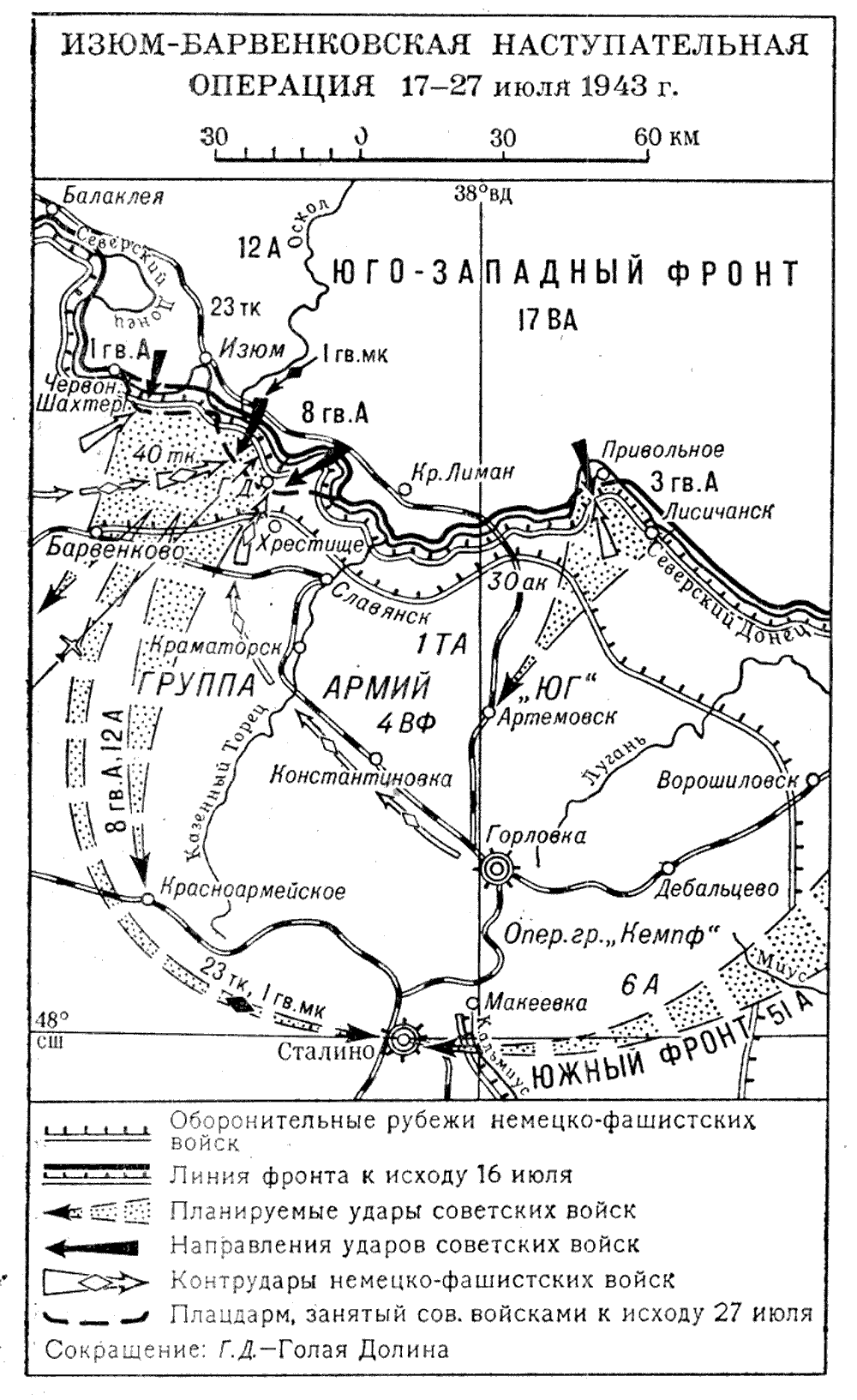
On the July 1943 began the battle on the Kursk salient. Soviet forces, located along Sievernyi Doniets river, made on 16th July an attack to the German lines. The main goal was to engage as much enemy forces, as possible, not allowing them to slip into the main battle, which had taken place on the north. Soviet troops crossed the river, and in intensive fights won some bridgeheads on its side - near the town Izyum (Изюм). These spots could be a good starting points for the future offensive, and Wermacht tried to push the Red Army back to the Sieviernyi Doniets. The Luftwaffe has prepared a “strike force” to support their ground troops…
On the morning of 17th July, eight La-5, led by capt. Nikolai Dimitriev (Николай Дмитриев), flew as the aerial cover of the Izyum bridgehead. At the end of their patrol they spotted over 40 German bombers, and 6 FW-190. Dimitriev bravely directed his fighters against enemy planes. They were Ju-87 - a good target to Soviet pilots: they knew all its vulnerable places. Four of the La-5 engaged the FW-190. The rest, led by Dimitriev, dived with high speed to the bomber’s formation. The array of Ju-87 weaved and dispersed. Soviet fighters used this occasion to attack the individual airplanes.
One Ju-87 caught fire – it was shot down on the pull out from the dive by Ivan Sytov. The second was shot down by Ivan Lavrienko (Иван Лавренко). He attacked “his” Junkers from the six o’clock, upward direction. The third was destroyed by Viktor Nikitin (Виктор Никитин). After this Sytov set the fire on another Ju-87…
In the same time FW-190 shot down the La-5 flown by Dimitr Sudariev (Дмитр Сударев). He jumped out with the parachute. German fighters killed him in the air.
Because the fuel was at the end, seven Dimitriev’s La-5s quitted the fight and directed to the airfield. They were replaced by other Soviet fighters, called before their attack. Whole engagement lasted about one hour. Both sides dispatched additional forces to support their units. Not only 5th GIAP, but also another Soviet regiment sent their fighters there. Finally, the German bombers did not reach their destination – Soviet troops at the Izyum bridgehead.
Of course, this episode in source [1] was exaggerated: its author reduced the number of the Soviet planes by half (from 8 to 4), and wrote, that Sytov was its commander. There is no mention about Dimitriev! He also transferred the single - engine Ju-87 into bigger, double - engine Ju-88 bombers. (Just increased the 87 to 88 – is was not so difficult!). It was quite possible to shot down two Ju-87 on a La-5 in single fight, as Sytov did. It would be much more difficult, if possible at all, to down two Ju-88 bombers on a La-5 in the same time. The author of [1] even went further: not caring about the reality, added another, third (!) downed Ju-88. I can see too much errors in it, to use it as reliable source of any information!
|
||
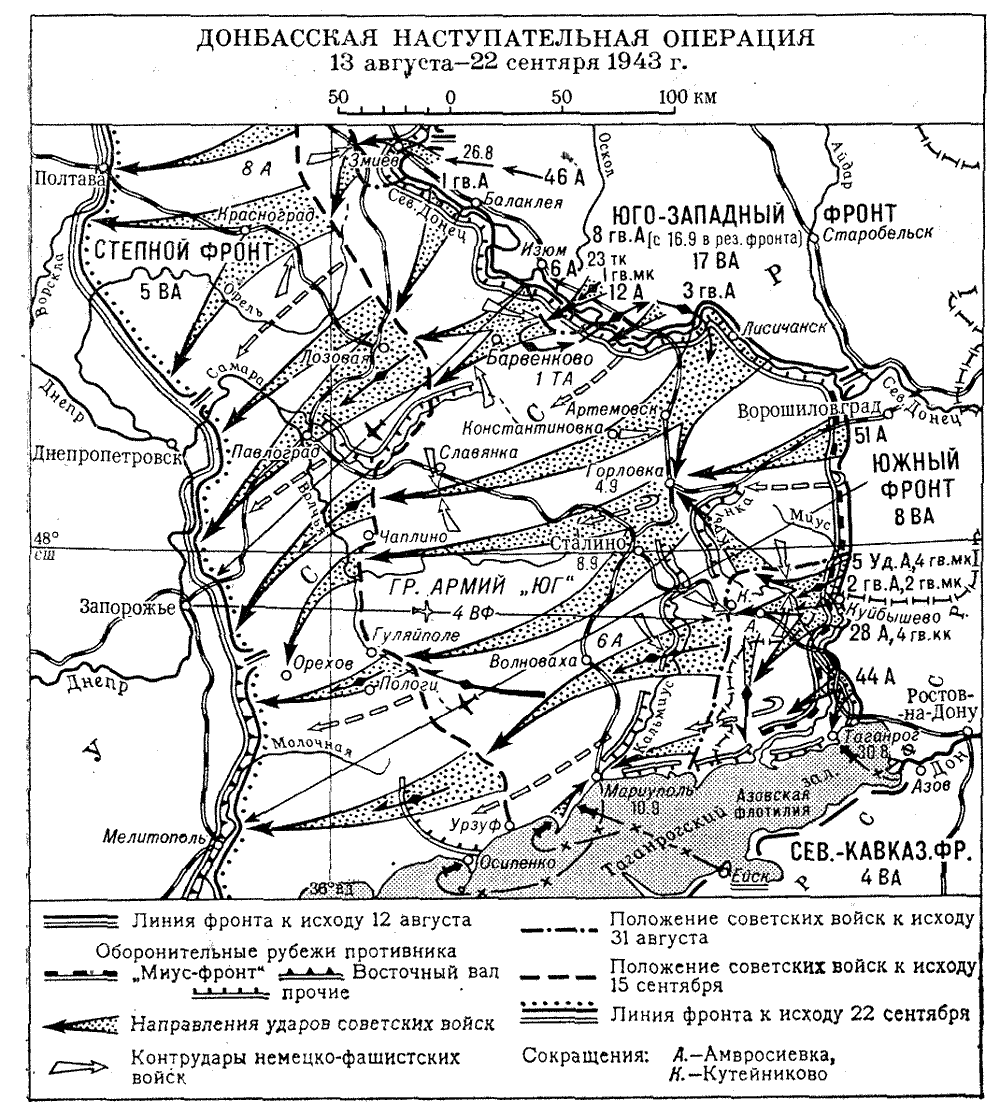
The battle on the Kursk salient had passed its climax, but was not finished, yet, when Red Army attacked on the wide front along the Donbass region (Eastern Ukraine). This operation was started on 13th August 1943. The bridgeheads near Izyum, captured a month ago, allowed to easier concentrate the strike forces on the north wing of this front.
On the
morning of 15th August four La-5, led by Ivan Sytov, patrolled the
air covering two airfields of their air division: Shchenyachye (Щенячье) and
Butsеvalovka (Буцеваловка). They met two Me-109, which tried to reach the area
around Butsеvalovka. Germans did not engage into the fight – they hid in the
clouds.
After some
time, Sytov received from ground radio station information, that five Me-109
are coming from the Zmiyev (Змиев) direction. He immediately led his group to
meet them. La-5 headed for the frontal attack. Seeing this, German pilots
turned away, to Chuguiev (Чугуев). (You can find both places on Map 1.)
Increasing speed, Sytov pursued them. The rest of his group followed.
Suddenly, a pair of Me-109 jumped from the clouds.
They engaged the three La-5, leaving the Sytov alone.
Vasilii
Kanus (Василий Канус) shot down the leader of this pair with an accurate burst
from both guns. This Me-109 hit the ground near Kochietok (Кочеток). The second
Messerschmit escaped back to the clouds, and did not appear again.
Following
the enemy planes, Sytov found himself alone against five German fighters. Soon
another four had appeared. They rounded Sytov’s airplane, filling the air
around him with traces of the gunfire. During this fight, they drifted toward
Kharkov. Selecting appropriate moment, Sytov attacked and downed one of the
German planes. It went down in the flames, and exploded on the ground.
Remaining eight continued their attacks with increased intensity. Sometimes
they reached the position to fire their guns, but Sytov always managed to break
from their fire, and respond back with an attack. He fought in his typical
manner: brave, with determination.
The
intensity of the fight was very high. Now they were directly over the city.
Form its streets observed them many groups of Kharkovians (it was a Sunday
morning). They could think that if the fighter with red stars flies over them – the front has been
moved, and Red Army regiments are coming again.
Under the
wing of the Sytov’s airplane appeared the main square, at the centre of
Kharkov. (One of the bigest in the world - no one can miss it!). Sytov fired a
long burst to a Me-109, which accidentally placed itself
in his gun sight, with proper deflection. On German plane appeared some flames,
but Sytov had no time to observe its further fate. Turning on the combat boost, he
escaped. His La-5 flew with maximum speed just over the roofs of the buildings.
Spectators maintain, that he weaved his wings on the farewell.
Some hours later on the same day, an AA shell has destroyed the plane of Sytov's squadron commander Vasilii Efimov. Efimov managed to reach the ground, but he was seriously wounded (lost one eye, had burns). Sytov replaced him as the commander of the squadron.
Soviet troops took Kharkov on 23rd August. Two day later some soldiers from 5th GIAP visited this city. Its inhabitants told them many grim stories about their fate under German occupation. They remained also the incredible fight of a single Soviet fighter against eight German planes. From the soldiers Kharkovians learned the name of that pilot. It become a local legend.
This story seems really incredible, but there were too many observers, to put this combat into doubt. It was a Sytov’s masterpiece, to get away from such situation alive. Anyway, from the technical point of view, it is possible. The maximum speed of La-5F at the sea level with combat boost (forsage) was about 555 km/h. This boost can be used below altitude 2000m. Me-109G2, although faster on the higher altitudes, had at the sea level maximum speed of about 510-520 km/h (it depend if the rear wheel was fixed, or not). If Sytov’s La-5F was in a good condition, that means if it had the performance similar to a new machine, he could escape them “on the roof level”. To succeed with this, he should bring all eight Me-109 down, to his altitude, before. (If they would left a pair of them somewhat higher, they would reach him in a dive). So, it seems that both sides made the errors in tactics, here. Sytov should not leave his group, and, at least his wingman should always follow him. German pilots were too self-assured, that they destroy the single Soviet fighter with an ease. They did not assigned any “upper reserve” for this fight (such reserve was a typical tactics in German fighter units). In effect, the “easy prey” escaped, destroying at least one of them.
Soviet offensive reached the line of Dniepr river on 22nd September 1943. Wermacht prepared deep defense there, and the front stabilized for a while.
Few days later 5th GIAP left his planes to another regiment, and was withdrawn from the front to a two-weeks break, for relax, after 116 days of intense fights. (i.e. June, July, August, September - [2], page 171). It may be, that the Sytov’s “white 18” went this way into another hands.
On 8th September three of the regiment’s pilots: lieutenants Vitalii Popkov, Ivan Sytov, and strashyi lieutenant Igor Shadrakov received the Hero of Soviet Union title. Shortly after this Ivan Sytov was promoted to strashyi lieutenant rank. The regiment’s commander allowed him to fly on an training U-2 airplane, to meet his family – the mother and younger brother - at Astrakhan (Астрахан). He returned back to the regiment after a week.
On 10th October 5th GIAP was back “at its business”, over Dniepr river. I do not think that Sytov received his “Valerii Chkalov” airplane back. Source [2] maintains, that this time the regiment received 10 La-5FNs - more enhanced version, with even better performance. It is possible, that a new airplane was handed to him, instead.
Red Army had to continue the attack. Its goal was to break German’s defense line, created along Dniepr river. Soviet ground troops attacked and captured on 14th October area around Zaporozhe (Запорожье) city. The new offensive was started.
On 16th October 1943 Ivan Sytov did not returned from the combat flight. His group covered the ground troops over the Zaporozhe. They met a group of Me-109s, and entered into fight. Sytov had disposed all his ammunition, but he continued to stay in the command of this fight. When the fuel was low, he went to his last attack. The soldiers from the ground troops confirmed, that they saw a Soviet fighter, destroying one Me-109 in a taran. But the pilot of this fighter did not looked around carefully. Another Messershmit a shot down the Sytov’s plane, a moment later. (It could be the wingman of destroyed Me-109). Both – soldiers on the ground, and fellow pilots from 5th GIAP in the air, looked with hope for a sight of the parachute. It did not appear.
In one year Ivan Sytov evolved from an ordinary pilot into the best fighter in the regiment. His life is rather typical for his generation:
Born in 1916, in Lipovka (Липовка) village, placed in Saratov region. Source [1] also maintains, that his family had a Bulgarian origin. It is not confirmed by any other source. The time of his childhood was a difficult period for the ordinary people – violence of the revolution and the civil war, then the post-war famine in the years 1922-23. After some relatively better years, in 1929 Stalin forced collectivization of all peasant possessions in USSR. It filled the labor camps on Siberia with new “enemies” – “khulaks”, and their families. For Sytov’s family it was also a difficult time – their father died. Fifteen years old Ivan moved to Astrakhan. He finished the primary school, there, and the vocational school at one of the industrial facilities, located in this city. It is very probable, that both of these schools were a boarding ones, offering the bed and meals for their pupils. In the years of big famine – 1932 – 33 – it was very important thing. For two years (most probably 1934-1936) he had worked at one of Astrakhan’s facilities as metalworker. In parallel he attended to the air training course on the Ossovakhim airfield.
After he finished it, he applied to the VVS school – probably on 1936. The typical air training in the army required 2.5 years, in that time. It means, that he could finish this flight school on 1939. It seems, that he was better than the others – and stayed in his Stalingrad’s flight school as an instructor. Then he has served in a fighter unit on the Far East. On 1942 joined the 788th regiment PVO, in the Stalingrad area.
He flown over 250 combat flights, downing – depending on of the source – 25 or 30 enemy planes individually, and 4 in the group.
Sytov was liked in the regiment. They missed his lively talks about the passed flights, fierce discussions about the tactics. He often illustrated his ideas, drawing appropriate sketches with anything, that was available at hand – usually with a stick on the sand…. Before a mission, Sytov liked ask, joking: “let me fly to make an order in the air”. They let him, and he flied “and made the order”. His colleagues called him “the fighter of the fighters”. But in all stories from his fights, presented here, he appears to be left alone. Maybe he had a problem with a proper cooperation with his wingman? It was direct reason for his death on 16th October, 1943: it seems, that nobody take care about his tail, at the moment of the last attack.
At the end, let me say something about my personal attitude. When I was making the model of his machine, I became curious, who flown it. Whom he was? I have read a lot in the Russian sources. The scraps of the information, I have collected, did not tell me too much about Ivan Sytov as a person.
It seems that he decided to be a professional soldier on 1936. He was a good one. It was a great advance for a village boy to become an airman. To be a soldier in a militarized country, like USSR, means, that you can be used in any war – not only the justified one. For sure, the Soviet troops that attacked Finland during the winter war (1939-40), were told that they are just defending their land. This kind of propaganda lies never changes.
Ivan Sytov had just a luck to enter into the fight on the side of the defenders. In that particular time – 1943, and particular place – Kharkov - the local people waited for the Red Army. Probably the oldest ones still remember the story of the Ivan Sytov's fight over the main square of the city.
[1] Герои страны
[2] Ильин Н.Г., Рулин В.П.: Гвардейцы в воздухе. — М.; ДОСААФ, 1973
[4] La-5, MBI 2007
[5] 5-й гв. иап, 22.06.41 г.
[6] aeroram.narod.ru - Сытов Иван Никитович, Кильдюшев Иван Гаврилович
[7] Артем Драбкин: Я дрался на истребителе. Принявшие первый удар. 1941 1942. - „Война и Мы”, 2003